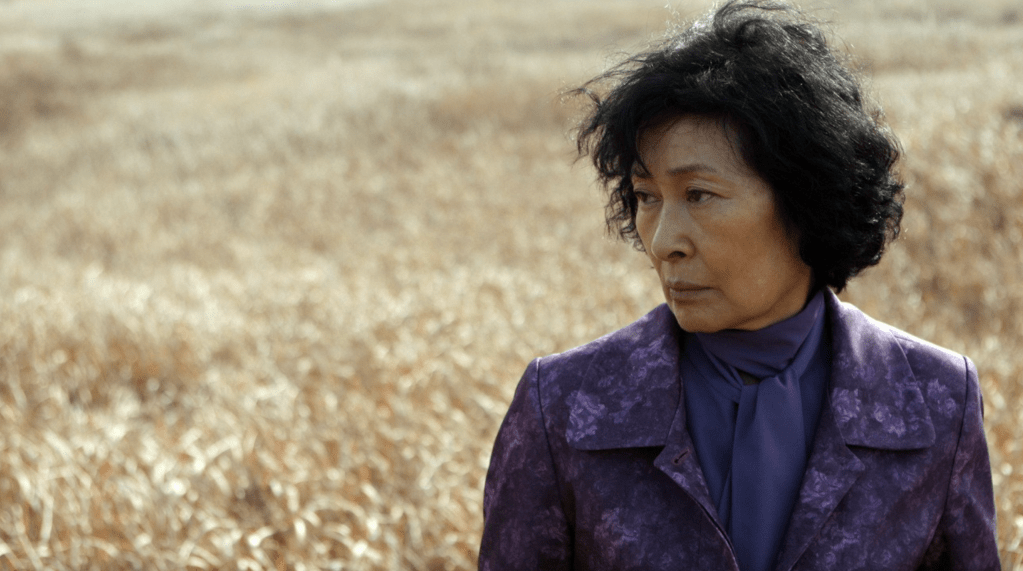
We never hear the actual name of Mother’s eponymous character; her maternal role so much consumes her life that it might as well have entirely supplanted everything else about her identity. The lead of Bong Joon-ho’s 2009 film is played by Kim Hye-ja, and she lives in a small South Korean town with her only son, Do-joon (Won Bin). Widowed years ago, she supports herself and Do-joon — an adult dependent on her because of an intellectual disability — by selling medicinal herbs and furtively offering discounted acupuncture without the proper licensing. The pair’s closeness raises eyebrows around town: many people whisper that they sleep in the same bed — something proven to be true — and in one scene, Do-joon’s mother spoonfeeds her son soup while he urinates in an alleyway in broad daylight. The only time he ever acts with any urgency is when someone calls him a slur mocking his disability — an insult that understandably can persuade him into otherwise out-of-character violence.
Do-joon’s mother’s always-on-alert parenting style is made clear nearly from the moment Mother begins. Do-joon is almost struck by a car while absentmindedly standing in the middle of the road, and she springs into action so quickly that it feels superheroic. Mother’s title character is already on another level of the parent-doing-anything-for-their-child cliché before Bong and his co-screenwriter, Park Eun-kyo, throw a wrench in their central pair’s life. A high-school girl’s body is discovered haphazardly flopped over a rooftop’s guard rail, and because of some telling circumstantial evidence — a golf ball with his name scrawled on it, for one — at the crime scene, Do-joon is the prime suspect for her murder. Bong tantalizingly confirms that Do-joon was definitely following the victim home on the night she was killed via flashback, but he cuts away before his innocence or guilt can be proven to the viewer.
That places us, for the most part, with Do-joon’s mother’s line of thinking as she starts an impromptu investigation of her own in a town where there is practically no one who thinks Do-joon was coerced into confessing to a crime he didn’t commit. Her son could very well be responsible, but there’s enough murkiness to engender some hope of this all being a tragic misunderstanding. Kim is phenomenal throughout the film as a character whose determination is as potent as it is chaotic. She’s the kind to make a scene at the victim’s memorial, thinking it an appropriate time not to mourn but to focus on her son’s so-far-improvable innocence. (Bong was adamant about casting Kim — who took years of cajoling before finally agreeing to the role — in part because of her strong association in South Korea as a motherly figure in more palatable TV and movie narratives.)
In classic Bong fashion, Mother — itself a return to “reality” after the sci-fi experimentations of 2006’s The Host — will not ultimately go the route of a more traditional crowd-pleaser that might see this dogged mother be straightforwardly vindicated. The movie, which has the same aslant sense of humor with which Bong’s movies have become associated, is more tricksy than that, more interested in the toxicity of protective parenting — something that poses much allegorical possibility — than its virtues. It’s hard to love — fitting for a film that knows all too well that love isn’t always easy.

