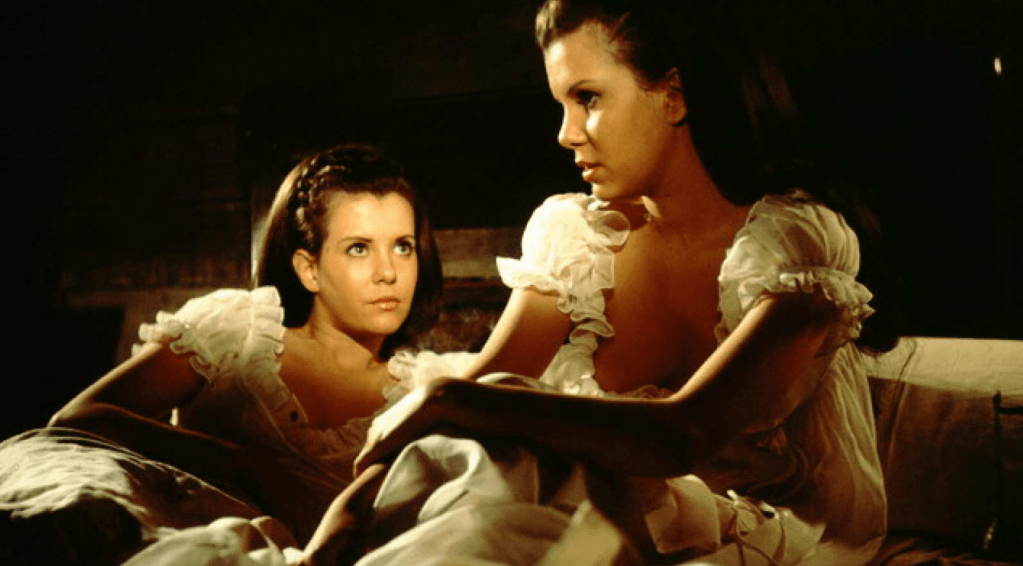
Twins of Evil (1971) is a misdirection of a title. Only one of the young women of the duo, Frieda (Madeleine Collinson), is a trouble-maker, while her identical sister, Maria (Mary Collinson), spends most of the film trying to be a voice of reason for a sibling whose only real fault (for a while) is that she sometimes gets too aggressive when someone tries stopping her from getting something she wants. It’s easy to be an apologist regardless of whether Frieda is definitely in the wrong, though. In this movie set in vaguely specified (but at least centuries-old) Stryia, Frieda is chagrined by the patriarchal reining in of women and lusts for a life where she can do whatever she wants. “Who wants to be good if being good is singing hymns and praying all day long?” she impatiently asks Maria.
That’ll get her into some hot water in Twins of Evil, a movie where neither she nor Maria is ever actually positioned as very villainous compared to some of the other forces at work in its setting. Trouble comes from precisely what she’s trying to rebel against. Shortly into the film, the twins, inexorably always in carbon-copy outfits that make it hard to tell them apart, are sent to live with their uncle Gustav (Peter Cushing) and his wife Katy (Kathleen Byron) after their parents die tragically. The two aren’t coming into a safe situation: Twins of Evil’s precredits sequence sees Gustav and a torch-wielding posse of men that calls itself “the Brotherhood” finding and then burning at the stake a local woman they’ve christened as a Satan worshipper. It doesn’t take much for this lot of religion-weaponizing misogynists to choose their next victim: one meeting concludes with them deciding that a woman they’ve heard lives alone in the woods poses a threat that must be eradicated. (When they happen upon a male corpse in the woods one evening sucked dry of his blood, they think no one but her could be responsible, with no evidence to back that up besides their suspicions.)
If the Brotherhood really must ambush anybody, their energy would be better expelled on Count Karnstein (an amazing, scenery-gobbling Damien Thomas), who lives high up in a castle fit for Dracula and whose bloodline has long lived for nothing but Satanism- and black magic-abetted debauchery. The Brotherhood knows as much — this is an occasion where Pizzagate-like chatter is mostly true — but the Karnsteins’ allegiance to the kept-offscreen emperor makes the powerful family basically impervious to any sort of consequence-free challenging. Karnstein, who openly mocks the Brotherhood for their pathetic ideologies and the ways they manifest them, is mostly a dilettante when it comes to the family interests that have kept the Karnsteins shrouded in infamy for generations. That changes when he impulsively decides to sacrifice a local woman, an act that summons an ancestor, the vampiress Mircalla (Katya Wyeth), to turn her scion into a fellow bloodsucker. (Twins of Evil is the third part of a Hammer Films-produced trilogy; 1970’s The Vampire Lovers and 1971’s Lust for a Vampire followed other Karnstein-related exploits during different eras of this made-up, loosely tied universe.)
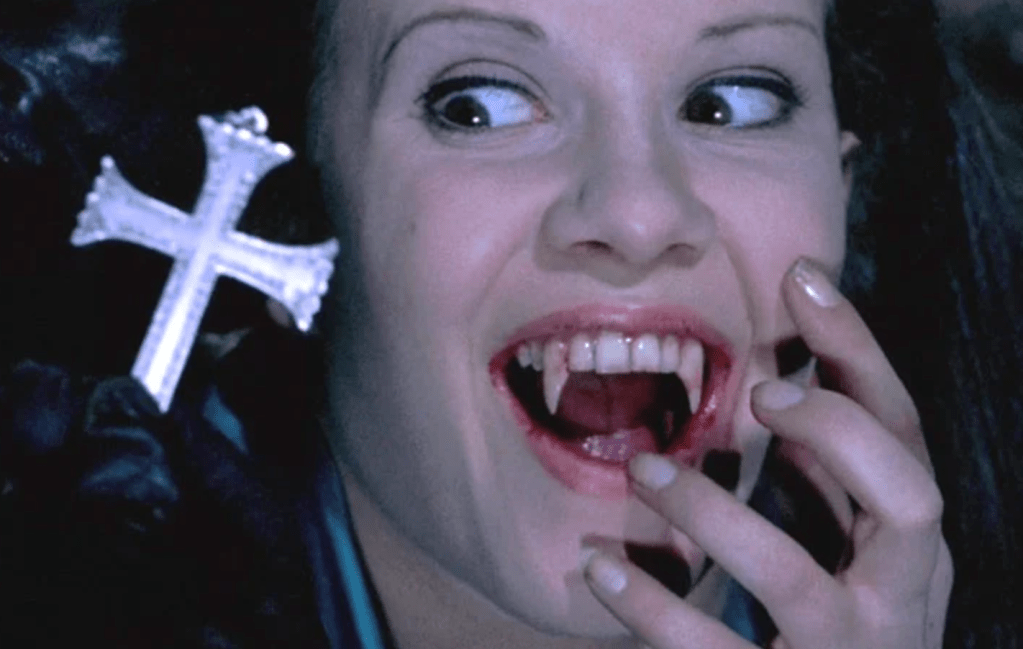
Madeleine Collinson in Twins of Evil.
Frieda accidentally also becomes a succubus after she sneaks out one night to see, for the badly needed thrill in a stuffy household forcing her to head to bed by 9, what all the fuss around Karnstein is about. She delights in a badness that now seems to come more naturally than ever, killing people — such as the eminently likable local schoolteacher — at random and giddily gazing back at the lack of reflection across from her in mirrors.
Though both Collinson sisters are inexplicably dubbed, that doesn’t do much to impede how good Madeleine is in this mischievous grin of a performance. She and the movie alike are better than they have to be: Twins of Evil exists mostly to capitalize on her and Mary’s sex appeal, which had recently been ravished in some glossy Playboy photos. The spread and this movie would suggest the start of a career for these very young women; instead the 19-year-old sisters traded their newfound notoriety for retirement soon after the film’s release.
Aside from the comically plunging necklines of the handful of outfits in which the Collinsons are made to slink around — the flimsy and obligatorily see-through white nighties seen in several after-hours scenes are particularly egregious — Twins of Evil turns out to be less of a cheesecake showcase with horror aesthetics but a decently sharp, and still pertinent, critique of puritanical hypocrisy and the rot at the center of religious zealotry. Cat-cheekboned Cushing is terrific as a deeply misguided crusader; you can’t help but laugh when he has what comes closest to a change of heart when the motivations behind his fanaticism are suddenly in his home. Some things never change.ell for the restrictions of a comfortably digestible plot. It’s a difficult but formally thrilling movie whose bedlam becomes easier to appreciate the more distance you’ve gotten from it.
 Peterson Reviews